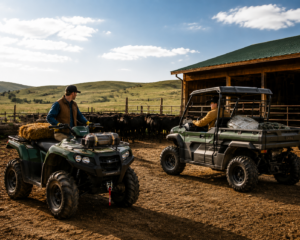
For ranch work, UTV towing capacity and UTV payload capacity can matter more than horsepower alone. The right utility side-by-side needs to handle the combination of people, tools, cargo, trailers, and terrain that make up a typical workday while still fitting through gates and around the property.
What Should Ranchers Look for in a UTV?
Ranchers should compare towing capacity, total payload, cargo-box capacity, vehicle width, drivetrain, braking, passenger capacity, and available work accessories. Do not compare towing or payload in isolation. The right UTV depends on the loads you regularly carry, the trailers you tow, and the terrain and property where you work.
What Is the Difference Between UTV Towing Capacity and Payload Capacity?
These ratings describe different jobs, and ranchers should look at both before choosing a machine.
UTV towing capacity is the manufacturer’s maximum rated weight for a trailer or other approved towed load for a particular model and configuration.
UTV payload capacity is the maximum weight the vehicle is designed to carry. Depending on the manufacturer’s definition, this can include the driver, passengers, cargo, accessories, and other loads.
Cargo-box capacity is a separate rating for the UTV’s bed. A machine can have a high overall payload rating while its cargo box has a lower maximum load.
For example, a Polaris RANGER XP 1000 NorthStar Edition Ultimate carries a 2,500-pound towing capacity, 1,275-pound maximum payload, and 1,000-pound cargo-box capacity.
At Craig Powersports, we recommend looking at the exact model’s published ratings rather than assuming every UTV in a category can handle the same workload.
How Much UTV Towing Capacity Do Ranchers Need?
Start with the loaded trailer weight, not the empty trailer weight.
A rancher who occasionally moves a small utility trailer has different requirements from someone regularly hauling equipment, feed, fencing supplies, or other heavier loads.
Before comparing UTVs, consider:
• What is the loaded trailer weight?
• How frequently will you tow it?
• Is the terrain flat, steep, muddy, rocky, or a combination?
• Will passengers and cargo also be inside the UTV?
• What hitch and trailer connection does the machine use?
• What braking and drivetrain capability does the job require?
Choose a towing rating that comfortably covers the loads you expect to tow rather than matching an occasional maximum load exactly.
A higher towing rating also does not automatically make a UTV the best choice for every ranch. Width, maneuverability, cargo space, braking, drivetrain, passenger capacity, and available accessories can all affect how useful it is around a working property.
Why UTV Payload Capacity Matters
Payload becomes especially important when several people and pieces of equipment travel together.
Think about a typical workday involving a driver, passenger, hand tools, fencing materials, feed, recovery equipment, and mounted accessories. The total load can add up quickly.
When comparing UTV payload capacity, account for everything the vehicle carries:
• People: Driver and passengers
• Cargo: Tools, supplies, feed, equipment
• Accessories: Winch, roof, windshield, storage systems, racks
• Mounted equipment: Other installed equipment or work accessories
Always check the exact manufacturer’s definition because payload limits and the way manufacturers calculate them can vary.
Don’t confuse payload with cargo-box capacity
Cargo-box capacity refers specifically to what the bed can carry.
Payload is the broader vehicle load rating and may include occupants, cargo, accessories, and other weight depending on the manufacturer.
That means a 1,000-pound cargo box does not necessarily mean the UTV can carry another 1,000 pounds of people and accessories on top of the box load.
How Much Payload Do You Actually Need?
Start with the jobs you perform most often.
| Ranch Workload | What to Prioritize |
| Fence repair and property checks | Maneuverability, storage, passenger capacity |
| Feeding and regular hauling | Payload, cargo-box capacity, storage |
| Trailer work | Towing capacity, hitch setup, drivetrain, braking |
| Snow and winter work | 4WD/AWD, traction, plow compatibility, protection |
| Regular crew use | Passenger capacity, payload, comfort, cargo space |
| Heavy utility work | Towing, payload, cargo capacity, drivetrain, accessories |
You don’t need the highest rating in every category. You need a configuration that comfortably matches the work you actually do.
What Makes a Utility Side-by-Side Good for Ranch Use?
For a utility side-by-side for ranch use, towing and payload should be part of a bigger evaluation.
1. Cargo Capacity
Look at the cargo-bed rating as well as total payload. A large bed can be useful, but only if its published limits support the loads you expect to carry.
2. Towing
Choose a tow rating that gives you appropriate capacity for your normal loaded trailer rather than building your entire decision around an occasional maximum.
3. Drivetrain
Selectable 2WD, 4WD/AWD, and appropriate traction modes can matter when moving equipment across changing terrain.
4. Dimensions
A larger UTV may offer more capability, but it also takes more room around gates, barns, sheds, trailers, and narrow property roads.
5. Work Accessories
A ranch-oriented machine can become more useful with equipment such as a winch, cargo organizers, roof, windshield, lighting, bed accessories, or other work-focused equipment.
Craig Powersports’ Parts Department can help source compatible UTV parts and accessories and assist with UTV customization.
Don’t Treat Towing and Payload as One Combined Rating
Towing capacity and payload capacity are separate limits.
A UTV rated to tow 2,500 pounds does not automatically mean that you can carry the maximum payload while towing 2,500 pounds at the same time.
Your passengers, cargo, accessories, trailer, hitch setup, tires, terrain, and the manufacturer’s stated limits all matter.
Always follow the specifications and owner’s manual for the exact UTV and configuration you are operating.
A Craig Powersports Example
The Polaris RANGER XP 1000 NorthStar Edition Ultimate is a useful example of why ranchers should compare more than engine size.
The machine has a 2,500-pound towing capacity, 1,275-pound maximum payload, 1,000-pound cargo-box capacity, and 65-inch overall width. It also has a factory-installed 4,500-pound winch.
Depending on configuration, a Farm/Ranch equipment package can also be available, which may include a bed extender/divider, rear headache rack, an auxiliary cargo-box winch, and additional work lighting. Confirm the exact package contents for the specific model and trim you’re considering.
For a rancher, that combination demonstrates why the right machine isn’t simply the one with the biggest engine. The more useful comparison is how the vehicle’s towing, payload, cargo, dimensions, drivetrain, and available equipment line up with the work.
Browse our current UTV inventory to compare configurations and confirm what’s available today.
Colorado Ranchers Should Consider the Terrain Too
Around Craig, Moffat County, and the Yampa Valley, a ranch UTV may need to handle uneven ground, snow, mud, rocks, changing grades, and narrow property access points.
That makes dimensions and drivetrain just as relevant as towing and payload.
Our ATV or UTV for Ranch Work and Colorado Trails guide covers the broader question of choosing between an ATV and UTV for ranch work. This article focuses specifically on comparing the towing, payload, cargo, and work-capacity specifications once you’re evaluating utility UTVs.
For recreational riding on covered public lands and designated trails, Colorado Parks and Wildlife requires applicable OHV registration or permits. Check current Colorado OHV registration requirements.
Compare UTVs for Ranch Work at Craig Powersports
The right UTV for ranch work should match your normal towing, payload, cargo, passenger, terrain, and property-access requirements.
Explore current UTV inventory at Craig Powersports or contact our team in Craig, Colorado to compare current utility side-by-sides and the specifications that matter for your workload.
FAQ
What is UTV towing capacity?
UTV towing capacity is the manufacturer’s maximum rated trailer or towed load for a particular model and configuration. Always check the exact vehicle’s specifications and owner’s manual.
What is UTV payload capacity?
UTV payload capacity is the maximum total load the vehicle is designed to carry. Depending on the manufacturer, this can include the driver, passengers, cargo, accessories, and other weight.
What is the difference between payload and cargo-box capacity?
Payload is the broader vehicle load rating, while cargo-box capacity refers specifically to the maximum load allowed in the UTV’s bed. The two ratings are separate, so always follow the manufacturer’s definitions and limits.
Does towing a trailer reduce how much payload a UTV can carry?
Towing and payload are separate ratings, but you should not assume that a UTV can carry its maximum payload while simultaneously towing its maximum rated load. Follow the manufacturer’s specifications for the exact vehicle, configuration, hitch setup, and towing conditions.
What is the best UTV for ranch work?
There is no single best UTV for every ranch. Start with your normal towing, payload, passenger, cargo, terrain, property-access, and storage requirements, then compare machines against those needs.