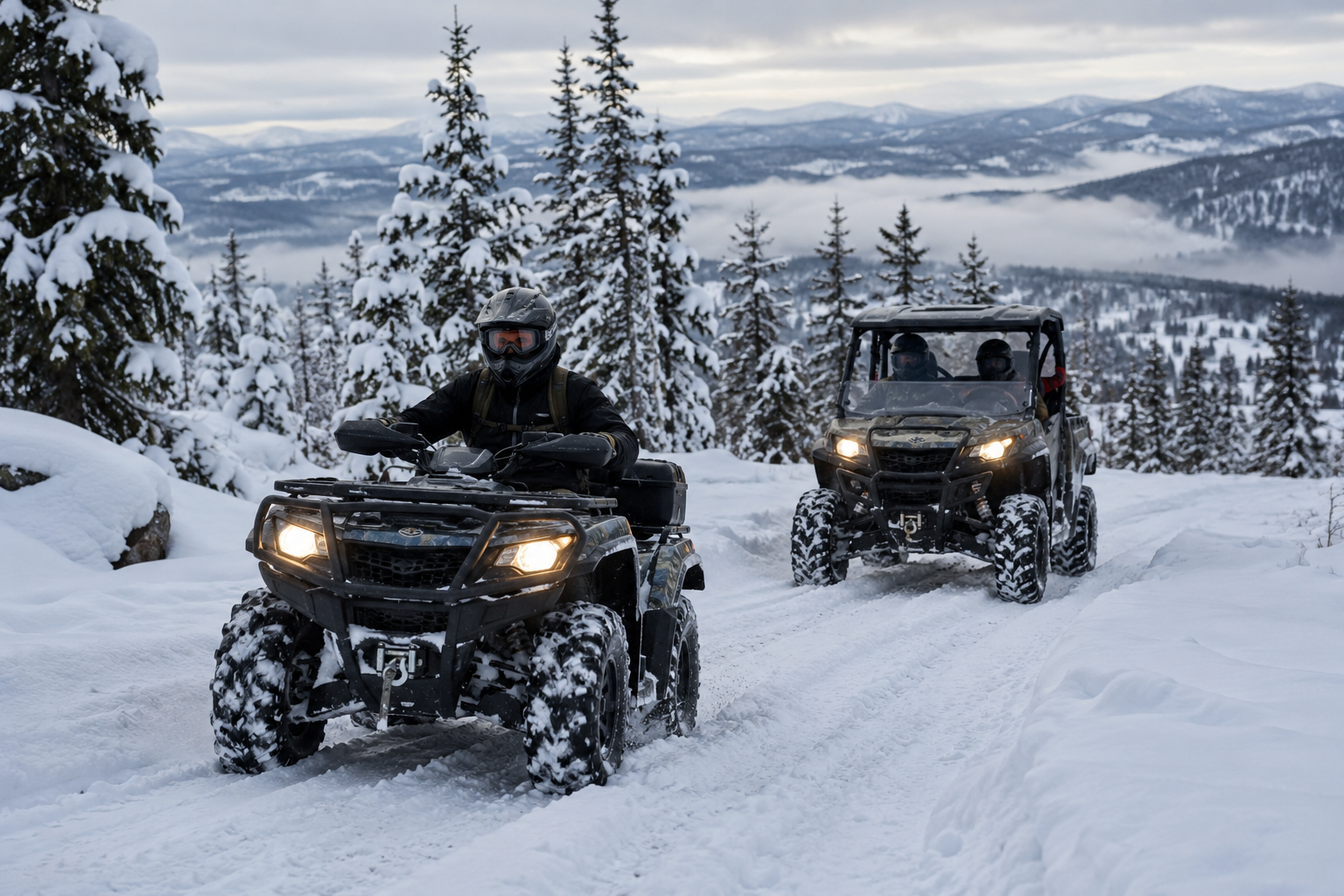
Winter ATV riding around Craig starts with one question: Is the route open to your vehicle today?
Snow changes traction, stopping distance, visibility, and recovery. Seasonal wildlife closures can also affect public-land access even when a route is available at another time of year.
For winter UTV riding and ATV trips around Northwest Colorado, check the route first, then prepare the machine, your gear, and a turnaround plan.
Winter ATV Riding: What Should You Check First?
| Before You Ride | Why It Matters |
| Current route access | Seasonal closures may affect winter use |
| Weather | Snow, wind, and visibility can change quickly |
| Avalanche conditions | Important if the route enters avalanche terrain |
| Tires and machine condition | Cold and snow expose weak batteries, tires, and drivetrains |
| Recovery equipment | Getting stuck in winter has bigger consequences |
| Clothing and emergency gear | A breakdown can leave riders exposed to cold |
| OHV registration | Colorado registration or permit requirements still apply |
The goal is not just getting onto the trail.
It is knowing you can safely get back.
Check the Route Before the Weather
Public land around Craig is managed by several agencies.
The BLM Little Snake Field Office manages public lands across Moffat, Routt, and Rio Blanco counties and maintains a current seasonal closures page.
BLM specifically notes that closure dates and boundaries can change depending on weather and wildlife conditions.
That means a route you used during summer may not be available for ATV winter riding in Colorado.
If you’re still deciding which vehicle best suits your needs, check out our guide on ATV or UTV for Ranch Work and Colorado Trails? to find the right fit.
Do not assume a visible track means your ATV or UTV is allowed there.
Check:
- who manages the land,
- whether the route is currently open,
- whether your vehicle type is allowed.
For broader Colorado route research, use COTREX and then confirm important restrictions with the actual land manager.
How Do Snow and Ice Change ATV Riding?
Winter reduces your margin for error.
Use smooth:
- throttle
- steering
- braking
And leave more stopping distance than you would on dry ground.
Snow can hide:
- frozen ruts
- rocks
- holes
- washouts
- ice
- soft shoulders
- deeper drifts
If the ATV starts pushing through turns, spinning excessively, or becoming difficult to stop predictably, slow down or turn around.
One of the most useful ATV winter safety decisions is knowing when the route is no longer worth continuing.
Winter UTV Riding Has Different Recovery Consequences
The same route-access and traction rules apply to a side-by-side, but a UTV adds passengers and more vehicle weight.
That means getting stuck can become a bigger recovery job.
For winter UTV riding, think about:
- enough warm gear for every passenger
- recovery equipment rated for the machine
- a shovel
- tire-repair equipment
- offline navigation
- communication
- how far you are from the truck or road
- whether everyone can stay warm if the machine stops
A cab, windshield, or heater may improve comfort on equipped machines, but they do not replace winter emergency planning.
If you need machine-specific winter accessories, Craig Powersports’ parts department can work from your vehicle’s year, make, model, VIN, and other information.
Check Weather and Avalanche Conditions
Craig’s weather does not automatically tell you what conditions will be like higher in the surrounding country.
Before leaving, check:
- temperature
- wind
- incoming snow
- visibility
- expected weather changes
If your route enters, crosses, or sits below avalanche terrain, check the Colorado Avalanche Information Center forecast.
CAIC advises checking the avalanche forecast while planning the trip and again before heading out for the day.
An ATV or UTV does not make avalanche terrain safe.
If you are not trained to recognize avalanche terrain, avoid assuming a machine track means the area is safe.
Cold-Weather ATV and UTV Inspection
Winter is a bad time to discover that the battery was already weak.
Follow the owner’s manual for the exact machine and inspect applicable items such as:
- battery and connections
- oil and fluids
- coolant
- brakes
- tires and pressure
- drive belt or drivetrain
- steering
- suspension
- lights
- winch
- visible leaks
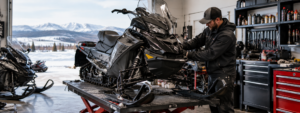
Craig Powersports’ service department currently services ATVs, UTVs, motorcycles, and snowmobiles and lists factory-trained service support for Can-Am, Polaris, Ski-Doo, and Yamaha.
If something has been hard to start, slipping, leaking, or making a new noise, deal with it before the winter ride rather than hoping cold weather improves it.
Tires, Traction, and Recovery
Start with tires that fit the machine and are in good condition.
Check:
- tread
- cuts
- sidewall damage
- wheels
- cold tire pressure
Use the pressure specified for your machine rather than guessing based on another rider’s setup.
If you are considering traction products, a winch, lighting, or other accessories, confirm compatibility with the exact ATV or UTV.
More aggressive equipment does not automatically make a closed route legal or deep snow manageable.
What Should You Carry for Winter ATV Riding?
A warm-weather inconvenience can become a cold-weather problem quickly.
Carry equipment appropriate to the distance and terrain, such as:
- insulating layers
- waterproof outerwear
- extra gloves
- water
- food
- first-aid supplies
- headlamp
- basic tools
- tire-repair and inflation equipment
- recovery strap
- shovel
- offline navigation
- charged phone or suitable communication device
Tell someone where you are going and when you expect to return.
When Does a Snowmobile Make More Sense?
An ATV or UTV can work well on a legal route with limited or packed snow.
Deep, soft snow changes the equation.
If most of your winter use involves deeper snow rather than mixed-surface riding, a snowmobile may be the more appropriate machine.
Craig Powersports’ current inventory lets you compare ATVs, UTVs, and snowmobiles based on what is actually available.
The right winter machine depends on the route, not just the season.
Colorado OHV Registration Still Applies in Winter
Colorado Parks and Wildlife requires OHVs to have the applicable current registration or permit for qualifying public-land operation.
CPW specifically includes:
- ATVs
- side-by-sides
- UTVs
- dirt bikes
Registrations and permits generally run from April 1 through March 31.
Check the current Colorado Parks and Wildlife OHV registration requirements before riding because resident, nonresident, and plated-vehicle requirements differ.
When Should You Turn Around?
Turn around when:
- the route is closed
- snow is deeper than expected
- traction is becoming unpredictable
- braking is getting difficult
- visibility is deteriorating
- someone is becoming too cold
- recovery is becoming harder
- fuel or daylight is running short
Turning around early is not a failed ride.
Getting the machine and everyone in it home is the goal.
Frequently Asked Questions
Can you ride an ATV in Colorado during winter?
Yes, when the route is legally open to that vehicle and conditions are appropriate. Seasonal closures can affect winter access, so check the land manager’s current information before each trip. For Craig-area BLM land, review the Little Snake Field Office seasonal closures.
Can a UTV be used in snow?
Yes, but practical limits depend on snow depth, terrain, tires, vehicle weight, and route conditions. Deep or soft snow can stop a heavy side-by-side quickly, so winter UTV riding requires realistic recovery planning.
What should I carry for ATV winter riding in Colorado?
Carry warm layers, weather protection, food, water, first aid, tools, tire-repair equipment, recovery gear, a shovel, navigation, and reliable communication appropriate to the area. The farther you travel from easy road access, the more important self-recovery becomes.
When should I check the Colorado avalanche forecast?
Check it whenever your route may enter, cross, or sit below avalanche terrain. CAIC recommends checking the forecast during trip planning and again before leaving. Review the current CAIC avalanche forecast.
Do I need Colorado OHV registration during winter?
Yes, the applicable OHV registration or permit requirements still apply. CPW’s current registration cycle generally runs from April 1 through March 31. Check the official CPW OHV registration page for your vehicle and residency situation.
Winter Riding Starts With the Route
Good winter ATV riding around Craig is less about pushing through snow and more about choosing the right day, route, and machine.
Check access. Check weather. Check avalanche conditions when relevant. Inspect the ATV or UTV before leaving. Carry enough gear to handle a delay.
That approach makes ATV winter riding in Colorado a lot more enjoyable than finding out halfway through the day that the route, weather, or machine was not ready for winter.